Beyond the deal — into the decision.

Consulting that meets the whole picture.

I work with founders, executives, business owners, and professionals across the business world — on the decisions made under pressure, the leadership transitions that come with scale, the quiet weight of being the one everyone looks to. Years inside the rooms where decisions actually get made. Strict discretion. Work sharp enough to use Monday morning.

Miami · Online worldwide
Independent advisory · By appointment
The foundation

Two things I bring, held together.

This is consulting that happens where personal depth and business reality meet. That's where I operate.

01First

Trained, not borrowed

This is consulting built on real preparation. A Bachelor's degree in the social sciences, a Master's expected in 2026, and years of formal study in how decisions actually get made — paired with direct experience inside the rooms where that work happens. The result: advisory that maps onto your reality, not frameworks borrowed from a leadership book.

02Second

Four years inside C-level operations

I worked directly alongside leaders in banking, investment, and trading. I watched what the pressure looks like up close — the decisions, the dynamics, the moments nobody sees. That experience stays with me in every session.

03Together

Consulting that holds up Monday morning

You need an advisor who can hold both layers at once — what the strategy needs and what the person making it can sustain. That's where real movement happens.

Does any of this feel familiar?

You're not the only one carrying it.

I've seen these situations from both sides — across the negotiation table, and in the quieter rooms afterwards, where what really happened gets discussed. I know how heavy these moments can feel. What the decisions actually cost. What people don't say out loud. You may recognize yourself in one of these:

  • i. When growth changes everything

    The phase where success starts arriving faster than the structures you built to handle it. Where what worked before no longer scales — and what comes next hasn't been built yet.

    A pattern I work with When growth is winning, but it doesn't feel like it.

    The founder encountered a rapid expansion in scope. Growth came alongside expanding responsibility, more complex processes, and a sharp increase in the number of decisions to be made.

    Externally, the trajectory remained positive. Internally, the experience was rising tension and a sense of dissonance with what was happening.

    Previous strategies for managing and deciding stopped providing the necessary stability. A sense of losing control surfaced — even as formal effectiveness was preserved.

    Analysis showed that the pace of external growth was outrunning the adaptation of internal structure. Mechanisms that had worked at the previous level do not automatically scale.

    The work was directed at rebuilding internal scaffolding: updating the approach to decision-making, expanding the tolerable level of uncertainty, adapting to a new threshold of responsibility.

    The result was that the founder became able to synchronize internal and external dynamics, sustaining growth without losing steadiness.

    A pattern I work with After you reach the goal — and the structure stops working.

    The client had achieved a goal toward which they had been moving consistently for an extended period. The key milestones were reached. The expected result was secured.

    What followed was a state of disorientation. The absence of a next goal led to a drop in motivation and a sense of having lost direction.

    Until that point, the structure of activity had been organized around reaching a specific outcome. Once the outcome was reached, that structure stopped working.

    Attempts to formulate a new goal did not hold. They felt manufactured.

    In the work it became clear that the issue was not the absence of goals, but the limitations of a model of self-definition built entirely around achievement.

    The focus shifted to expanding the frame of reference: developing a longer-range vector not anchored to a single point of result, and integrating new sources of meaning into the work itself.

    The result was that the client recovered a sense of direction without needing to manufacture artificial pressure through new goals.

  • ii. When the decision is heavier than the data

    The moments when the analysis is done, the spreadsheet is clear, the path is visible — and you still can't move. Because what's holding you isn't the information. It's everything underneath it.

    A pattern I work with When the data is clear, and you still can't decide.

    The client was in a situation that required a specific decision. The data was available, the scenarios calculated, the risks understood.

    In spite of this, the decision kept being deferred. The formal explanation was the need for additional verification and parameter refinement.

    What was actually happening was avoidance of the moment of deciding. This was accompanied by accumulating tension and a gradual deterioration of conditions.

    The absence of a decision, in this case, was generating a rising cost of inaction: missed opportunities, declining flexibility, intensifying external pressure.

    In the work it became clear that the limiting factor was not the quality of information, but the relationship to consequences. The decision was being experienced as a potential mistake with high personal cost.

    The focus shifted to the perception of responsibility and the tolerable level of risk. This made it possible to lower internal resistance and move into action.

    The result was a decision made in conditions of sufficient — rather than complete — certainty.

    A pattern I work with When everything is, for once, going well.

    The client was in a state of sustained effectiveness. Key indicators remained at a high level, decisions were made on time, the system functioned without disruption. What was missing was the sense of being engaged with what was happening. Results were achieved, but not experienced as significant.

    Attempts to change the state by increasing the workload or complicating tasks produced only a short-term effect. Return to the baseline state happened quickly. This pointed not to a lack of stimulus, but to a disconnect between external outcome and internal experience.

    In the work, it became clear that the client's motivational structure had been built around achievement as the primary mode of self-definition. The capacity to actually live the result was never developed as a separate skill. This produced a cumulative effect: rising demand for outcomes without rising satisfaction from them.

    The focus of the work was not on changing external strategy, but on reconfiguring the internal system: restoring subjective response, separating outcome from identity, expanding the range of states available outside of achievement.

    The system continued to function at the same level. What changed was how it was experienced from inside.

  • iii. When holding it all together becomes the problem

    The point where the very habits that built your reputation — control, ownership, being on top of every detail — start working against you. When something has to shift, and it can't be deferred any longer.

    A pattern I work with When holding it all together starts holding the team back.

    The client occupied a central position in management and was deeply involved across all processes. Control extended through both strategic and operational layers.

    Initially this ensured a high quality of decisions. But as the system grew, the opposite effect began to surface: declining initiative across the team, dependency on the client for decision-making, and slowing of internal processes.

    A closed loop had formed. The lower the team's autonomy, the greater the need for control. This intensified the load on the client and limited the system's capacity to scale.

    In the work it became clear that control was performing not only a managerial function, but a compensatory one. It reduced uncertainty and maintained a sense of stability.

    The focus shifted to redistributing responsibility and working with tolerance for uncertainty. Delegation was approached not as a management tool, but as a change in the internal model of relating to the system.

    The result was greater team autonomy and a reduced need for constant oversight — without loss of decision quality.

    A pattern I work with When something has to give — and it can't be deferred.

    The work began at a moment when the situation could not be deferred. External circumstances had shifted in such a way that the usual modes of management stopped functioning.

    The client was operating in survival mode: reduced clarity, an inability to lean on prior experience, focus narrowed to short-term reactions.

    In situations like these, strategic thinking is temporarily unavailable. The first task is to restore the ability to think clearly.

    The work began with steadying the ground: returning the capacity to hold attention on what mattered, separating facts from interpretations, lowering the intensity of the noise.

    As clarity returned, it became possible to come back to analysis of the situation and to deliberate decision-making.

    The result was that the client moved out of reactive mode and into managed action — even as the external complexity remained.

  • iv. When pressure stops being temporary

    The shift from "this is a hard quarter" to "this is just how things are now." When the intensity stops being a phase and starts becoming the baseline — and stepping back feels like more risk than staying in.

    A pattern I work with When pressure stops being the situation and becomes the air.

    For an extended period, the client had been functioning under high external pressure: deadlines, expectations, responsibility.

    Initially, the pressure was tied to specific circumstances. Over time, it became part of the internal state.

    Even in the absence of external triggers, a sense of needing to keep moving remained. Tension stopped depending on the situation and became background.

    This led to declining quality of recovery and a gradual depletion of resources. External effectiveness was preserved, which made the problem harder to identify in time.

    The work was directed at restoring the boundary between external and internal — building the capacity to complete processes within oneself, not only at the level of circumstances.

    The result was that pressure stopped being a constant state and began returning only in situations where it was actually warranted.

    A pattern I work with When stopping feels riskier than continuing.

    The client demonstrated a high capacity for work and consistent engagement with operational processes. Externally this looked like an advantage. Yet any attempt to step back produced significant tension.

    Time off was not experienced as recovery, but as risk. A sense of losing control would surface, compensated for by a return to work. Over time, this consolidated into a stable behavioral pattern.

    In analysis it became clear that constant activity was performing not only an operational function. It was also a way to keep difficult signals quiet. Work had become both a tool for achieving goals and a method of avoidance.

    In this mode, effectiveness is preserved but resilience declines. Any forced pause amplifies internal pressure and affects the quality of decisions.

    The work was directed at separating activity from identity: developing the capacity to tolerate stopping without losing one's footing, and finding stability outside of constant doing.

    The result was that the client retained their effectiveness while no longer depending on continuous activity as the only way to hold themselves steady.

Every example shared above is a composite, altered to protect client confidentiality. Any resemblance is coincidental — but the patterns described are real, and reflect the work I do.

How I work

Depth, without the theatre.

The consulting is practical. We look at what's real, we talk about what matters, and we build capacity that holds up Monday morning. No abstract jargon. No performative rituals. Just focused, honest advisory work.

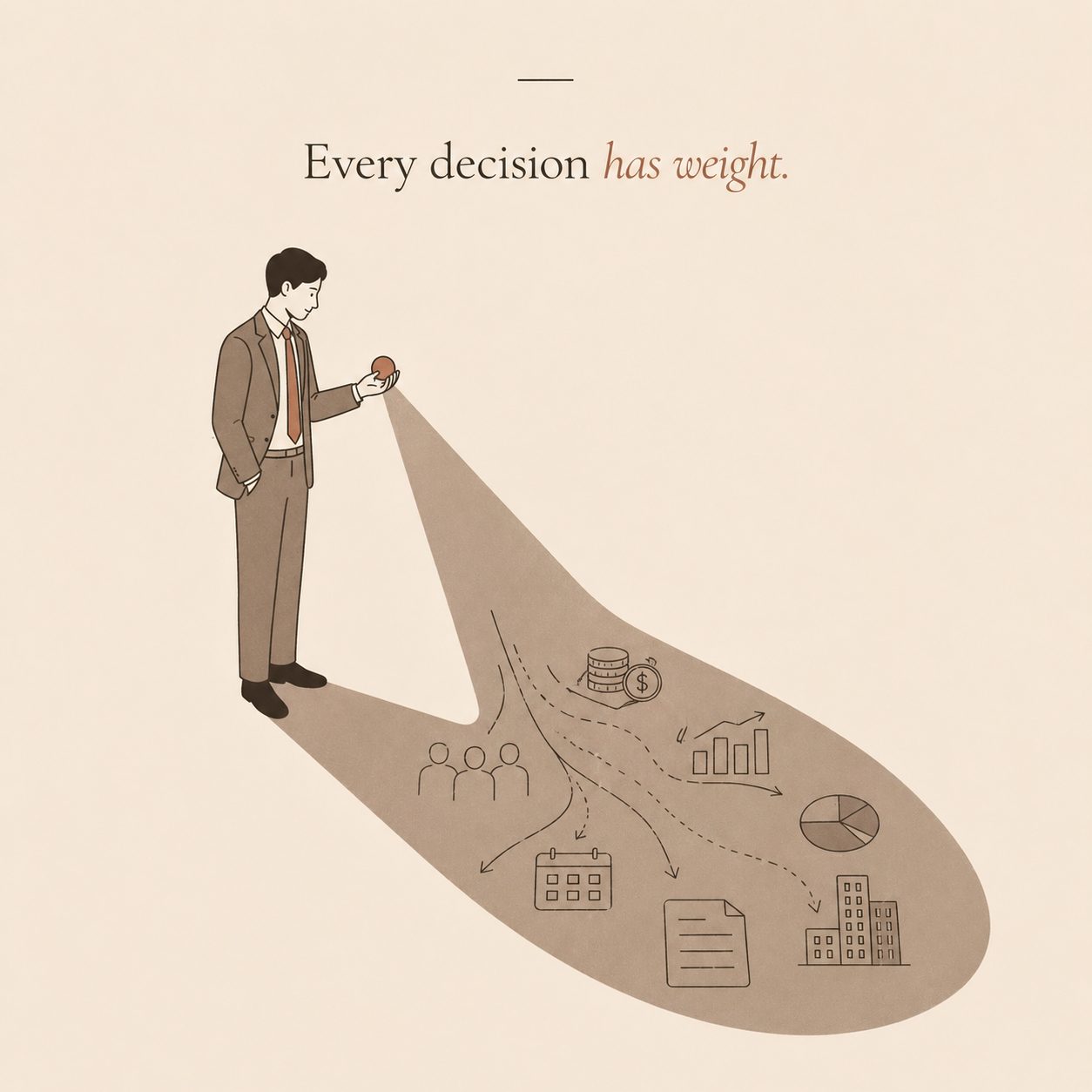
Illustration — a small decision casts a long shadow of consequences
The weight a decision can carry.

Consulting depth meets business reality

This is advisory work that integrates years of formal training with four years of direct experience inside executive operations. You get both layers — strategic and personal — held by the same advisor. Not one pretending to be the other.

Available when it matters

I'm reachable between sessions for the moments that can't wait — a difficult call in an hour, news that just broke at 2am, a decision that has to land before market open. The hardest moments rarely respect calendars. Neither does my work with clients.

Strict discretion

What we discuss stays between us, subject only to legal and safety obligations. I have worked in environments where discretion is the entire foundation of trust, and I carry that standard into every engagement.

Outcome-focused, not session-focused

This is advisory that earns its place. We're not filling hours — we're sharpening specific problems and building real capacity: clearer decisions, steadier presence, the kind of composure that changes the temperature of the room when you walk in.

The whole picture

The work version of you isn't a separate person.

What looks like a work problem often has roots elsewhere. What shows up in your decisions — usually has more behind it than the boardroom can see.

A figure balancing on a seesaw between work and personal life
The balance you carry, every day.

A founder's short temper with the team is sometimes really about a decision they haven't made yet. Decision paralysis often reflects an older pattern of overriding one's own judgment. Exhaustion isn't just about hours — it's about meaning, alignment, and what's been silently traded along the way.

My consulting doesn't treat the work version of you as separate from the rest of you. Leaders don't actually function that way. How you sleep affects how you negotiate. The conversation you've been avoiding shapes the conversation you have instead. Personal context shows up in how you handle conflict with a co-founder, even when neither of you can name it.

This doesn't mean every advisory conversation goes broad. It means when something in your business isn't shifting, the consulting stays open to why — and sometimes the answer is in a room the conversation hasn't entered yet.

On approach

How I work

This is consulting that meets what's actually happening — not what should be happening, not what looks good in the boardroom narrative. We work with the living situation in front of us: the pattern that keeps showing up with certain team members, the deal you've been quietly avoiding, the thing you almost said in the last meeting. Sharp, deliberate, present. That's where real movement happens.

A place to think

A room with no audience.

You bring whatever is real for you that day. Nothing has to be edited, justified, or made presentable first.

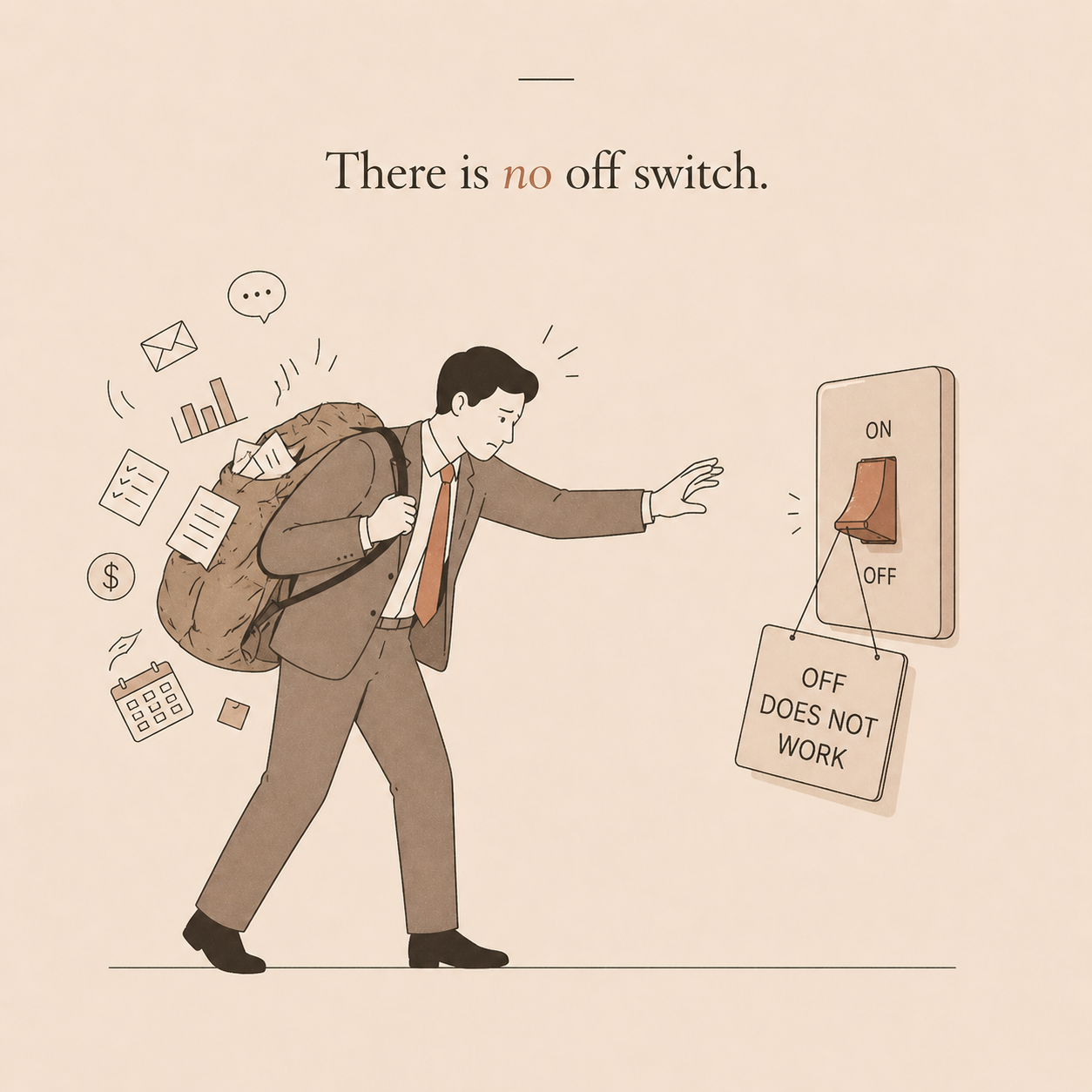
Illustration — a person trying to reach an off switch that does not work
There is no off switch.

You have plenty of people you can talk to about strategy. This is the room for the part that doesn't fit those conversations — the thinking that needs more space than a meeting can hold.

That's what this is. A consulting space — not therapy, not clinical work, not another coaching framework. A space built on the fact that most of us spend our days being legible to others — and almost none of it being honest with ourselves.

  • The thought you haven't said out loud
  • The doubt you're not sure is legitimate
  • The anger you're too measured to name in the meeting
  • The pride you'd never mention, and the shame that lives next to it
  • The fear of being found out — by the team, the board, yourself
  • The fatigue of performing, even when the performance is working
  • The relationships that don't fit neatly into any framework
  • The questions about what any of this is actually for

All of it has a place here. None of it leaves the room.

Services & Engagement

Four ways to work together.

One rate. Transparent pricing. Payment is handled securely through the booking system — no invoices, no awkwardness. Every engagement starts with a free discovery call, so you can see how it feels before committing.

Start here · Free

Discovery Call

A complimentary first conversation. To meet, to feel the room, to see whether the work could be a good fit. Forty-five minutes, no obligation.

  • Online
  • A genuine conversation, not a sales call
  • No commitment to continue
Individual

Single Session

A focused 60 minutes on one specific challenge. Useful for one-off clarity or to see whether we work well together.

$250 per session · 60 minutes
  • Online
  • Brief written follow-up
Book a session
Monthly

Monthly Package

Four sessions over a month. The rhythm at which momentum starts to build and patterns become visible.

$900 4 sessions · 1 month
  • Weekly 60-minute sessions
  • Between-session availability
  • Discount vs single sessions
Start this month
Extended

6-Month Partnership

For sustained high-stakes periods. When change needs time to fully take root.

$5,000 24 sessions · 6 months
  • Weekly 60-minute sessions
  • Between-session access for urgent moments
  • Initial 90-minute onboarding call
Begin the partnership
For organizations

For companies supporting their leaders.

A team is more than the people on the org chart — it's the steadiness the business actually runs on. The clarity behind every decision, the resilience under pressure, the trust that holds when things get hard. When that layer is supported well, the whole organization moves better.

For companies supporting leadership development, team wellbeing, or specific executive engagements, I offer custom proposals. Every organization is different; every engagement is scoped to the actual situation, with confidential reporting, coordinated scheduling, and continuity across the team.

Engagements may include

  • 011:1 coaching for founders, executives, or key team members
  • 02Team workshops — half-day, full-day, or ongoing series
  • 03Monthly retainers with flexible session allowance
  • 04Leadership development programs across 3–12 month arcs
  • 05Change management support during growth or restructuring
  • 06Confidential board-level reporting when appropriate

Tell me about your situation

A few quick details and I'll be in touch personally to set up an initial conversation. Everything you share is confidential.

About

I spent four years watching how the top of the room actually works.

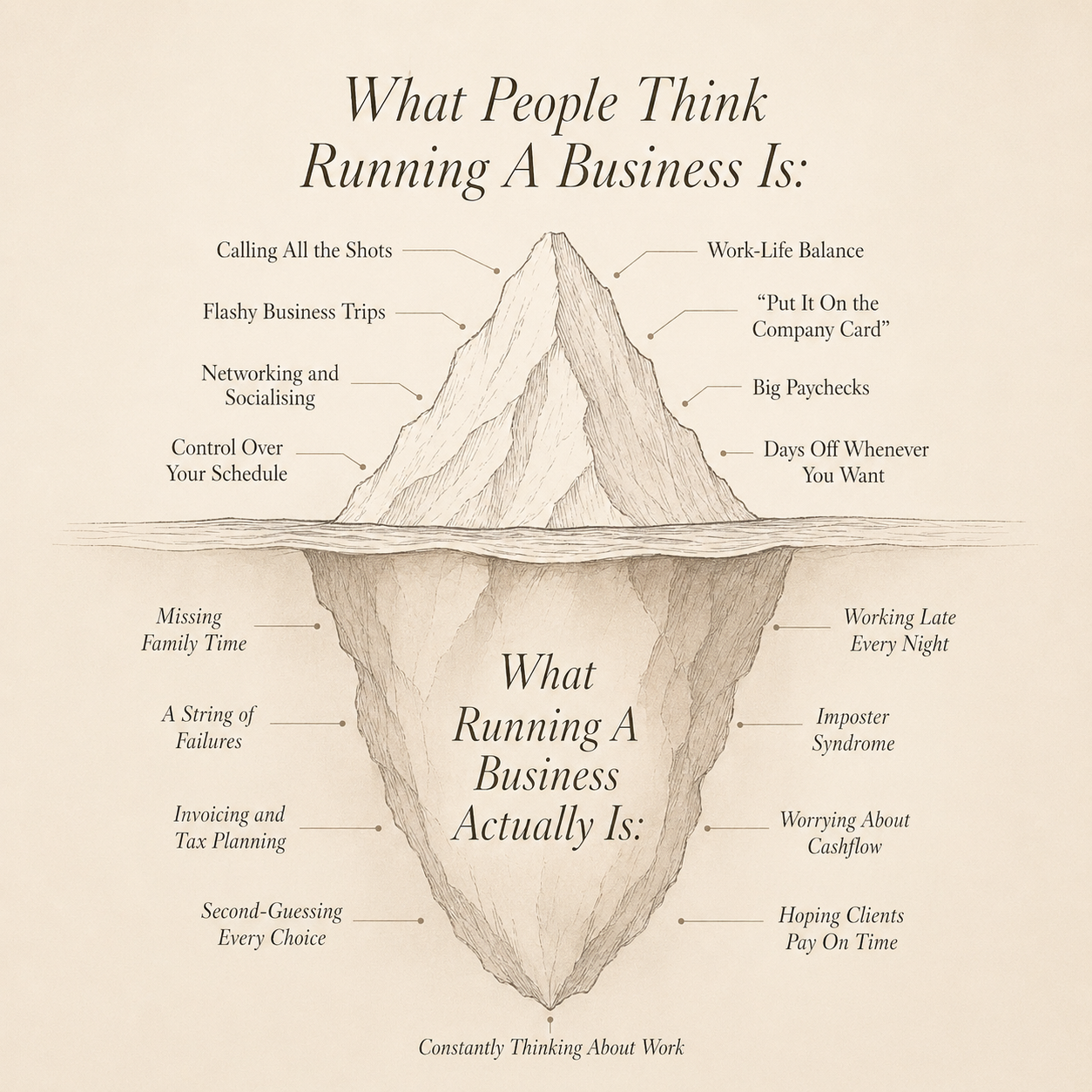
Iceberg illustration — what running a business looks like above and below the surface
What running a business looks like — above and below the surface.

Before building my independent advisory practice, I worked as the right hand to senior leadership across banking, investment, and trading — first in Switzerland, and now in the United States, where I continue to work alongside the business world while building this practice. I wasn't observing from the outside — I was in the room. Every board meeting, every investor call, every difficult conversation about a deal that wasn't going to work, every moment when a leader had to make a decision they hadn't been ready for. I saw it from a vantage point most consultants never have access to.

My exposure was never limited to one office or one corner of the business world. I've worked alongside professionals across many fields — different industries, different vocabularies, different definitions of pressure — but a remarkably similar inner landscape underneath. That breadth is part of why my clients don't have to translate their world to me. I've seen most versions of it already.

That kind of proximity changes what you understand about leaders. I've been next to founders through wins that didn't feel the way they expected, and through losses that tested everything. I've seen the quiet panic before a difficult announcement, the exhaustion behind the steady voice, the loneliness of being the one everyone looks to. I know what it looks like when a leader loses themselves in the work — and I know what it takes for them to come back.

What I bring to the table is genuinely uncommon: years of formal training in how decisions get made and how leaders hold up under them, built on top of real, embedded experience inside high-stakes business operations. Most consultants understand the boardroom but not what's happening underneath it. Most who understand human dynamics don't know the boardroom. I built this consulting practice deliberately to hold both — so my clients can speak about their work and their reality in the same conversation, without choosing one to be heard.

When you work with me, you're not explaining your world from scratch. You don't need to translate what a Series B looks like, what it feels like to fire someone you respect, what happens when a market move at 2am threatens everything you've built. I've been in those rooms. I've watched these decisions land. I know what they cost.

My academic background includes a Bachelor's degree in Psychology and a Master's expected in July 2026, alongside additional methodology training obtained outside the United States. None of these credentials have been evaluated by U.S. licensing or accreditation bodies. After completing my Master's, I will explore the formal process of professional licensure in the United States — the next step in a career I've been deliberately and patiently building. In the meantime, I work as a business consultant and executive advisor, and the work focuses on the one thing I believe matters most: helping clients find clarity. Not just to be successful in the eyes of others — but to feel that success in their own.

A steady mind makes better decisions than a reactive one. That steadiness — under real pressure, in real time, when the stakes are actual — is what I help build. Quietly. Deliberately. Without theatre.

Education
B.A. Psychology, Kyiv · M.A. Psychology, expected July 2026 · U.S. professional licensure process to begin upon completion of Master's degree (July 2026) · Credentials obtained outside the United States, not yet U.S.-evaluated
Methodology
Additional methodology training obtained internationally (not certified by any U.S. body), applied in a business consulting and executive coaching context
Experience
Over four years of independent work in business and consulting — first in Switzerland, and now extending across the wider European market.
Practice
Based in Miami, Florida · Online sessions worldwide, including European clients · In-person Miami by arrangement
Languages
English · Also serving Russian- and Ukrainian-speaking clients
Confidentiality
What is shared in session stays in session. Any client examples published anywhere are altered in identifying details to protect confidentiality, while preserving the truth of the dynamic — never the person.
Begin

Book a discovery call, or a session directly.

The starting point can be a free 45-minute discovery call, or a paid session if you already know what you want to work on. Whichever you choose — pick a time, and I'll see you there.

i.

Choose your session

Discovery call (free) or paid session. Pick a time that works for both of us.

ii.

Pay & confirm

For paid sessions, secure payment through Stripe. Full refund if you cancel 24+ hours ahead.

iii.

Meet online

You'll receive confirmation, a calendar invite, a reminder 24 hours ahead, and the meeting link — automatically.

How payment works: All sessions are paid securely via Stripe at the moment of booking. You'll receive a receipt by email automatically. Cancellations 24 hours or more before the session receive a full refund. All payments, calendar invitations, and meeting links are handled automatically — there is nothing to manage.

Or, simply

Write to me directly.

mia@sindeeva.com
Miami, Florida Online worldwide By appointment